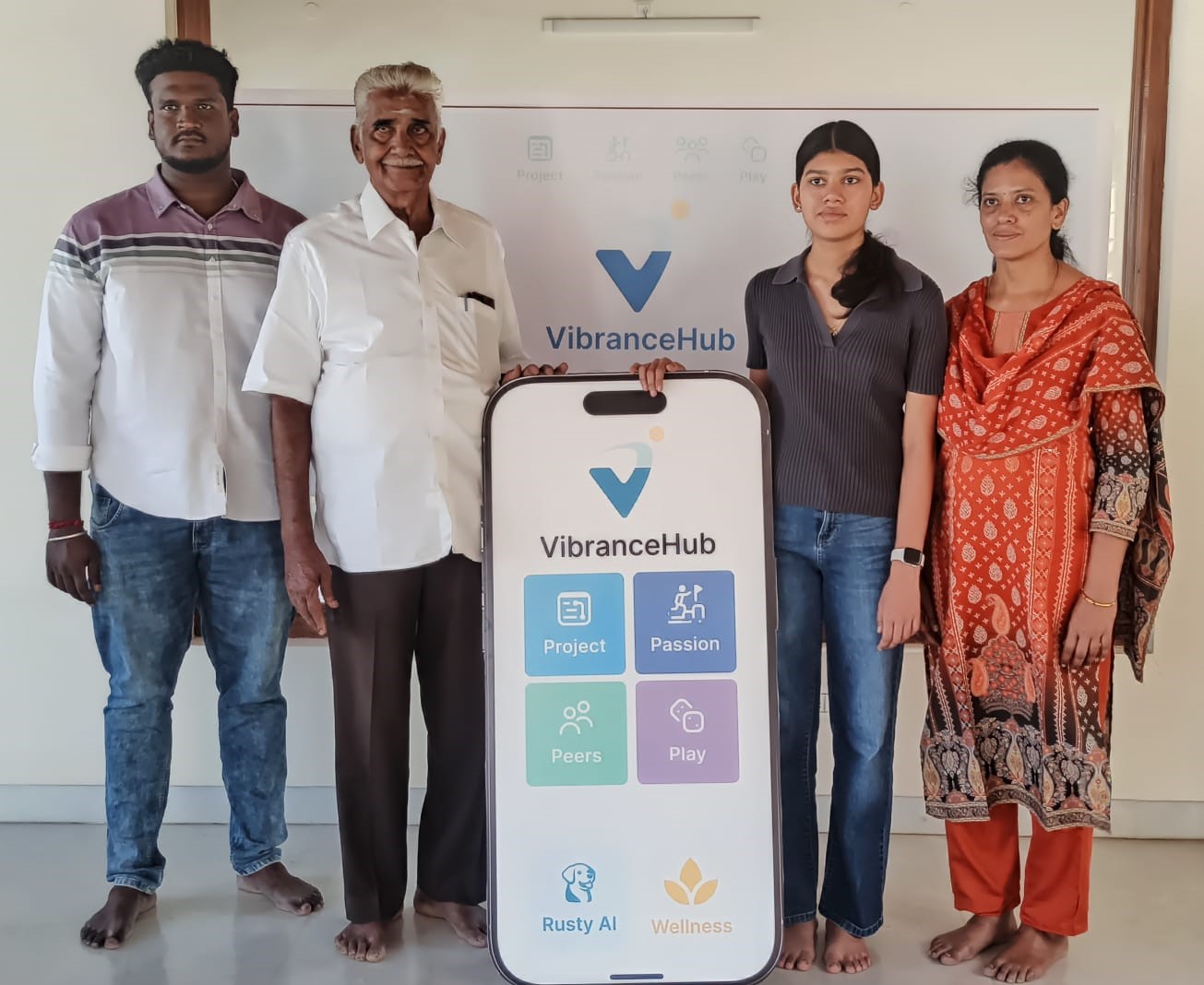


COIMBATORE — Rithanya Sivaram, a Class 12 student at The Indian Public School, has launched Vibrance Hub, a pioneering platform designed to enhance project-based learning through peer collaboration and integrated yoga-based wellbeing. This initiative seeks to fill a critical gap as India readies its students for an AI-driven future where creativity and sustained innovation take precedence over rote knowledge.
“In the age of AI, information is commoditized. What truly matters is what you can create, how you think, and whether you can maintain creative work over time,” says Sivaram. “While Atal Tinkering Labs provide essential tools and spaces for tinkering on a national scale, Vibrance Hub offers the necessary scaffolding, community, and wellness practices to transform student interests into sustained innovation and creativity.“
Developed based on MIT’s Lifelong Kindergarten framework—comprising Passion, Projects, Peers, and Play—Vibrance Hub emphasizes that maker education transcends mere construction. It nurtures vital skills such as computational thinking, resilience through iteration, and effective collaboration, all of which current AI technologies cannot replicate.
Children often tackle challenges with fearless experimentation. However, years of standardized testing and a “correct answer” mentality gradually strike down that confidence. They become apprehensive and self-critical, hesitant to venture into the unknown without a guarantee of success. This erosion of creativity leads many to internalize the idea that they simply aren’t creative people anymore.
Vibrance Hub represents, in various ways, a return to India’s educational roots. Before the imposition of a rote-learning system by Macaulay’s Minute on Education in February 1835, India’s traditional gurukul approach emphasised experiential learning. Here, students engaged directly with subjects—learning metallurgy by forging, understanding astronomy through observation, and gaining medical knowledge via practical experiences.
The National Education Policy 2020 advocates for the revival of this maker-centric pedagogy, acknowledging that the future prosperity of India hinges on fostering creators and innovators rather than mere information repeaters.
Moreover, the Atal Innovation Mission (AIM), initiated in 2016 by NITI Aayog, signifies India’s most ambitious attempt to embrace the maker-centric philosophy on a national scale. AIM directly aligns with the NEP 2020’s directive to encourage creativity and innovation by establishing tangible infrastructures for hands-on learning throughout the country.
Through Vibrance Hub, Sivaram aims to inspire a new generation of thinkers and creators. With a focus on mental wellness integrated alongside project-based learning, the platform promises to address the evolving educational needs of students as they prepare to navigate an increasingly complex world.
Sivaram’s efforts highlight the critical importance of education innovation, asserting that teaching students to create and collaborate will equip them with the essential skills for future success. As India transitions into a future dominated by technological advancements, initiatives like Vibrance Hub may well be the key to nurturing the next wave of thinkers and innovators.