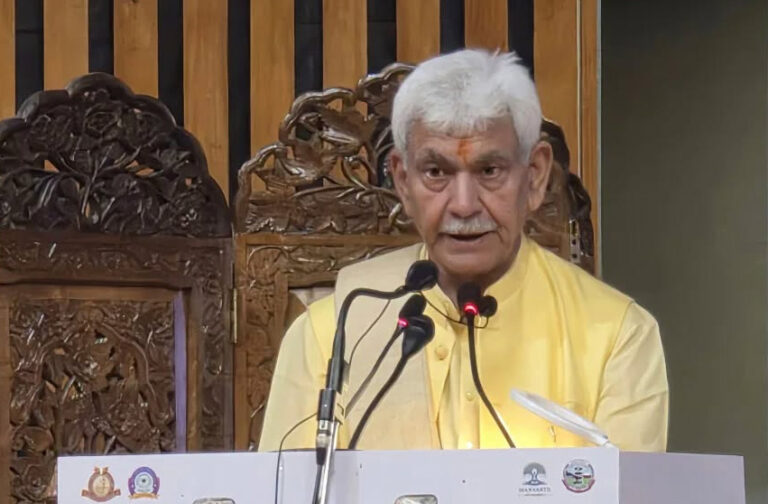


Lieutenant Governor Manoj Sinha announced on Monday that major regions across India have successfully overcome terrorism. He noted that only a few pockets remain affected while the majority of the northeastern states have become terrorism-free. Addressing issues in Jammu and Kashmir, he claimed local recruitment into terrorist activities has sharply declined.
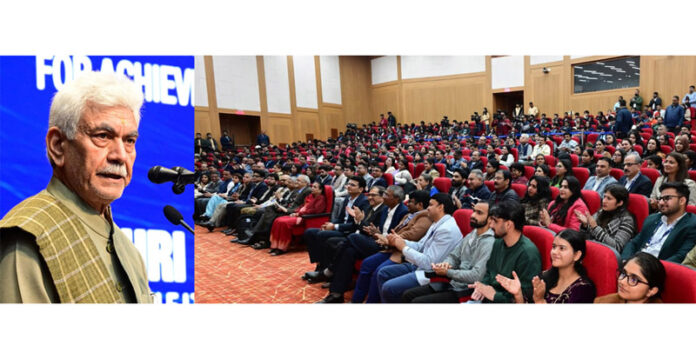
Sinha made these remarks during the three-day Strategic Management Forum (SMF) Conference focused on policy-making and strategic planning for achieving Viksit Bharat by 2047 at the Indian Institute of Management (IIM), Jammu. He provided insights into the government’s ongoing efforts to combat terrorism and enhance safety in the region.
Large swathes of the country have freed themselves from terrorism. The threat from left-wing extremism and Naxalism, once a serious concern for states like Chhattisgarh and Odisha, has been reduced significantly.
“Most of the northeast is now free from terrorism,” Sinha stated. “The threat of left-wing extremism and Naxalism aimed at creating a corridor from Hyderabad to Nepal is now limited to just two or three districts.”
Focusing on Jammu and Kashmir, he asserted that the landscape of terrorism has shifted dramatically. “Currently, no top commander of terrorist organisations is active in the region. The recruitment of local youths into terrorist ranks has seen a catastrophic drop,” he said, revealing that only one or two individuals join terrorist groups now.
However, Sinha highlighted the persistent threat from infiltrators across the Pakistan border. He warned that these individuals often hide in dense forests and rugged terrains. “I assure you they will be eliminated. No matter how long it takes, they will not survive,” Sinha assured the public.
The LG noted a troubling shift in terrorism dynamics, where knowledgeable and educated individuals are now becoming involved in these activities. “The battle against terrorism cannot rest solely on the shoulders of security forces. In areas like Jammu and Kashmir, Karnataka, and Kerala, society and certain administrative sectors must take active roles,” he added.
Emphasising the need to bridge divisions, Sinha called for an end to the divisive “insider-outsider” narrative. He argued that perpetuating such divisions creates obstacles in development efforts.
In his vision for a developed India by 2047, Sinha asserted that entrepreneurs and policymakers play vital roles in navigating the myriad challenges the nation faces. He stressed the necessity for continued focus on economic stability, substantial investments in education and healthcare, the integration of digital technologies, participatory governance, and effective project implementation.
Asserting the growing confidence among industry leaders, the Lieutenant Governor praised India’s rapid growth under Prime Minister Narendra Modi’s leadership, noting positive developments in the manufacturing and services sectors. “The PM’s call for Swadeshi has invigorated industries including village handicrafts, which now compete globally,” he added.
During his address, Sinha underlined Jammu and Kashmir’s underutilised potential in mining, stating, “J&K is rich in limestone, sapphire, lithium, and various other minerals. With strategic planning, we can generate an additional annual revenue of ₹15,000 crore to ₹20,000 crore within the next five to seven years.”
He called for an enhanced focus on the hydropower sector and proposed reforms to adjust the Holistic Agriculture Development Programme (HADP) to meet the evolving economic needs of the region.
Celebrating cultural heritage, Sinha inaugurated the Basohli Painting Exhibition and presided over the concluding session of the Basohli Painting Workshop, honouring local artists. “Basohli Painting is our unique artistic legacy, holding immense value for generations to come,” he remarked, commending the collaborative efforts between IIM Jammu and the Indira Gandhi National Centre for the Arts (IGNCA).
The event gathered prominent figures including Prof B.S. Sahay, Director of IIM Jammu; R.K. Chaudhary, Chairman of JERC Jammu and Ladakh; Subash Chandra Meena, Economic Advisor at NITI Aayog; and notable academicians, policymakers, industry leaders, artists, and students who contributed to the forum’s dynamic discussions.