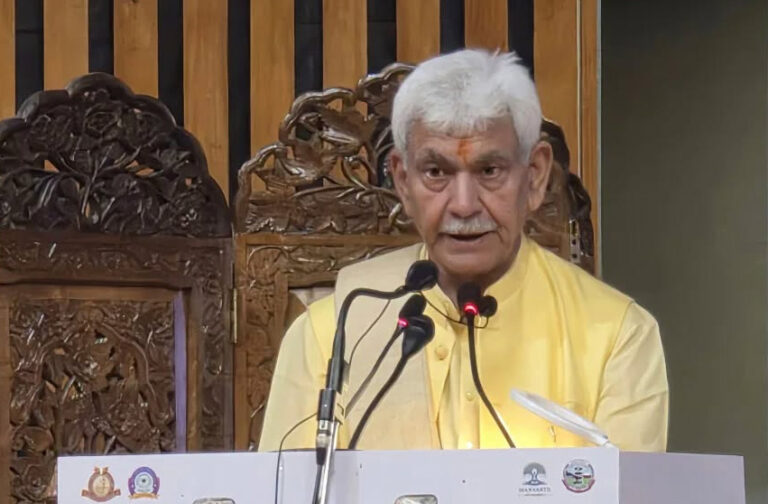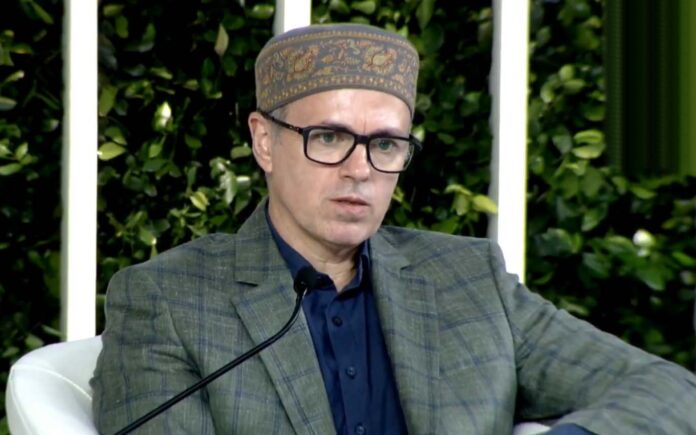


Jammu and Kashmir Chief Minister Omar Abdullah publicly labeled his office as one of “disempowerment” during an event on Wednesday. Abdullah expressed his concerns about the limitations imposed on his role as he leads a Union Territory (UT) with significantly less authority compared to his previous tenure in a State. He highlighted this transition as a “unique misfortune” where he now oversees a UT with powers “far less than any other State Chief Minister” in India.
At the gathering, Abdullah delivered a forthright critique of the current administrative framework in Jammu and Kashmir. He accused the Lieutenant Governor’s office of regularly interfering in his roles, emphasizing the need for a defined timeline for the restoration of Statehood. Abdullah stated, “It is very difficult to reconcile the terms ‘Union Territory’ and ‘Jammu and Kashmir’ in the same sentence.” He reiterated his discomfort, asserting that the officers under his directive once emphasized their allegiance to being part of a ‘State’, a sentiment that now starkly contrasts with the UT status.
Abdullah criticized what he referred to as an “asymmetrical” distribution of power between the Jammu and Kashmir administration and the Lieutenant Governor, Manoj Sinha. He pointed out that the Lieutenant Governor holds various key positions traditionally associated with an elected government, such as chairmanship of the Jammu and Kashmir Power Development Corporation and convening tourism meetings in Gulmarg. Abdullah questioned, “What business does someone responsible for security have holding a tourism meeting?”
He also alleged that an IAS officer was appointed to an important position, typically reserved for the Jammu and Kashmir Administrative Services (JKAS), to undermine elected government control over the Information Department. Abdullah mentioned that several significant cabinet decisions, which include altering reservation percentages, remain pending approvals from the Lieutenant Governor’s office.
On the issue of Statehood restoration, the Chief Minister reminded the Centre of the previously outlined three-step process: delimitation, elections, and Statehood. With two steps complete, he posed the question, “Why are we made to wait for the third?” Abdullah invited the Centre to clarify its intentions, stating, “If it is when the BJP comes to power, then be honest so that the people can make informed decisions.”
Regarding the restoration of Article 370, he asserted that it would only be feasible following a change in the central government, claiming, “It is pointless asking the people who took it away from us to give it back.” While he affirmed his commitment to restoring the special status, he vowed not to deceive citizens with unrealistic promises.
Abdullah also raised concerns regarding governance and radicalization, criticizing what he termed “hyper-nationalism” and collective punishment practices, such as demolishing homes in response to terrorist acts. He pointed out the absurdity of punishing innocent communities and relearning from these actions to prevent further radicalization.
He illustrated this by mentioning incidents following the Pahalgam attack, where numerous homes were destroyed only to later reveal no involvement from local Kashmiris. He queried, “If those people are radicalized, whose fault is it?” Abdullah further highlighted recent controversies in sports teams and medical college admissions, where objections arose due to the predominance of Muslim candidates. He stated, “When you push an entire community to the margins, how can you expect no reaction?”
On the national political front, Abdullah characterized the opposition alliance, INDIA bloc, as being in a precarious state, likening its viability to being in the “ICU” or dependent on “ventilator support.” He noted that critical issues like Article 370 currently do not feature on its agenda. Furthermore, he defended Congress leader Rahul Gandhi, acknowledging the political landscape as one where such issues could derail a potential election victory.
Breaking from the perspective of his father, Farooq Abdullah, Omar asserted that he does not subscribe to the belief of EVM tampering. He emphasized personal accountability for electoral losses, attributing challenges to constituency delimitation rather than alleged machine misconduct.
Earlier in his address, Abdullah touched on environmental challenges plaguing Jammu and Kashmir, such as pollution and the extended dry spells in Srinagar, attributing these issues to the valley’s unique geography that traps smog. He clarified misconceptions about tourism being the primary economic driver in Jammu and Kashmir, revealing that tourism stands fourth in terms of its contribution to the Gross State Domestic Product, following agriculture, horticulture, and industry.