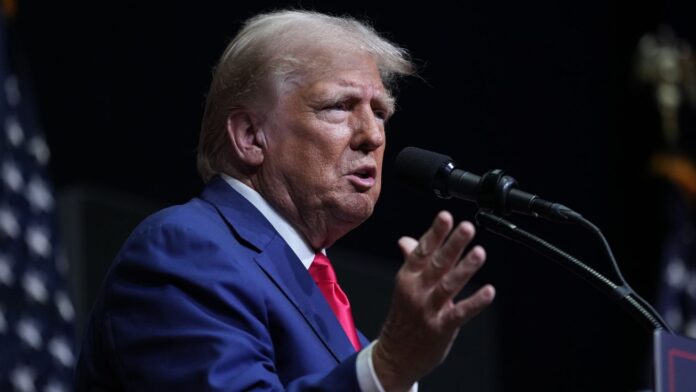


President Donald Trump has paused “Project Freedom,” a military initiative designed to escort vessels through the strategically important Strait of Hormuz, claiming significant strides in negotiations with Iran towards a peace agreement.
In a statement posted on Truth Social on Tuesday, Trump declared, “Great progress has been made toward a complete and final agreement with representatives of Iran.” He emphasized the need for this pause to potentially finalize the deal, reflecting a shift in the U.S. approach to a complex geopolitical situation.
Trump explained, “Based on the request of Pakistan and other countries, coupled with our tremendous military success in the campaign against Iran, we have mutually agreed to pause Project Freedom for a short period to assess the potential for a finalized agreement.” He noted that while the maritime blockade remains, the initiative will be temporarily suspended to focus on negotiations.
Launched just days earlier, Project Freedom aimed to escort ships stranded in the Strait of Hormuz, a critical chokepoint for oil transport globally. Trump had unveiled the operation on Sunday, and it began implementation immediately the following day. However, the initiative sparked tensions in the area.
The Strait of Hormuz seeps through a vital route that facilitates approximately one-fifth of the world’s oil supplies. Recently, the UAE reported incidents of its vessels being attacked, allegedly by Iranian forces. In response, the U.S. destroyed several Iranian small boats, marking heightened military engagement.
Trump’s announcement coincided with U.S. Secretary of State Marco Rubio’s declaration regarding the conclusion of Operation Epic Fury, which began on February 28. Rubio conveyed confidence as he commented on the achieved objectives of the operation during a White House press conference.
Rubio stated, “Operation Epic Fury is concluded. We achieved the objectives of that operation. We’re not cheering for an additional situation to occur. We would prefer the path of peace. What @POTUS would prefer is a deal… that is, so far, not the route that Iran has chosen.” This statement reinforces the ongoing tension and complexity around U.S.-Iran relations.
Discussing Project Freedom, Rubio highlighted the primary goal of rescuing nearly 23,000 civilians from 87 different nations who found themselves stranded in the Persian Gulf, largely left vulnerable by Iranian actions.
He emphasized, “This is not an offensive operation. This is a defensive operation, meaning there’s no shooting unless we’re shot at first. We’re not attacking them, but if they’re attacking us or they’re attacking a ship, you need to respond to that.” This assertion indicates a careful balance by the U.S. administration, attempting to manage military and diplomatic actions simultaneously.
As both political and military narratives unfold, the effectiveness of ongoing diplomatic negotiations remains to be seen. Trump’s administration, undergirded by complex military strategies, navigates through webs of diplomacy and defense as tensions linger over Middle Eastern peace and security.