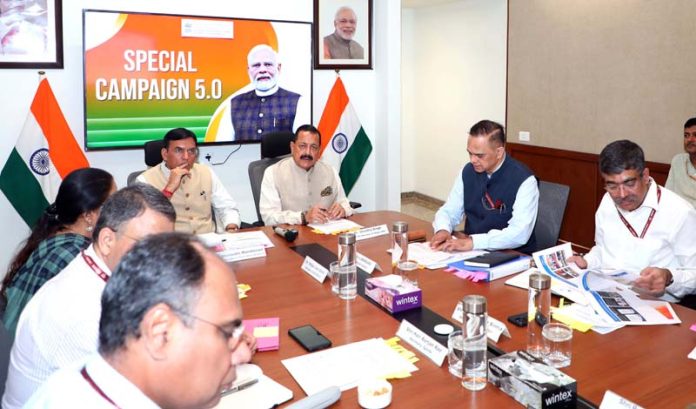


Union Minister of State (Independent Charge) for Science & Technology, Dr. Jitendra Singh, initiated a call for transforming the Government’s ongoing cleanliness initiative into a mass movement. At a high-level review meeting held on Special Campaign 5.0, he proposed a joint effort among ministries and departments, urging them to weave public participation, innovation, and private sector engagement into the clean-up drive.
Dr. Singh emphasized the importance of moving beyond symbolic gestures in cleanliness efforts, urging officials to institutionalize cleanliness, space optimization, and record management. He stated, “We should integrate technology, community engagement, and private sector collaboration to ensure that the campaign sustains itself throughout the year.”
In support of the initiative, he outlined plans to leverage corporate partnerships and collaborations with MSMEs through NASSCOM. This strategy aims to introduce innovative waste management solutions, focusing on urban clusters, hotels, and government establishments. The minister highlighted the potential of integrating digital technologies and smart recycling models, enabling initiatives like automated waste segregation and electronic scrap management.
Such enhancements could not only elevate operational efficiency but also create new livelihood opportunities across society. Dr. Jitendra Singh underscored the significance of sharing best practices among ministries, advocating for national dissemination of successful cleanliness models from public spaces to educational campuses through a centralized repository.
Furthermore, he suggested identifying innovative strategies, including electronic file disposal, smart waste reuse, and repurposing cleared government land, to set new benchmarks in governance. By engaging youth and women, the campaign could harness renewed energy and creativity. “When young people and women join the movement, it becomes more vibrant and impactful,” he remarked.
His call to amplify Swachhata messages through schools, colleges, and initiatives like My Bharat volunteers aims to foster a culture of collective responsibility. Reflecting on past successes, Dr. Singh noted that the Special Campaign has evolved from a short-term cleanliness drive into a transformative governance model. This evolution promotes efficiency, transparency, and citizen-centric administration.
He assured attendees that the Government remains committed to sustaining this momentum under the leadership of Prime Minister Narendra Modi. Innovative best practices arising from the campaign would also be shared with States, PSUs, and autonomous bodies.
In a related effort, Union Minister of Health and Family Welfare, Dr. Mansukh Mandaviya, addressed the meeting, highlighting the necessity of behavioural change and youth participation in realizing the vision of “Swachh Bharat.” His suggestions included appointing student and youth ambassadors from colleges and universities to spread awareness and motivate communities to uphold cleanliness and hygiene in their areas.
The meeting also saw participation from senior officials such as V. Srinivas, Secretary, DARPG; Sarita Chuhan, Joint Secretary, DARPG; and other key representatives from various government ministries aimed at enhancing the collaborative nature of this cleanliness initiative.