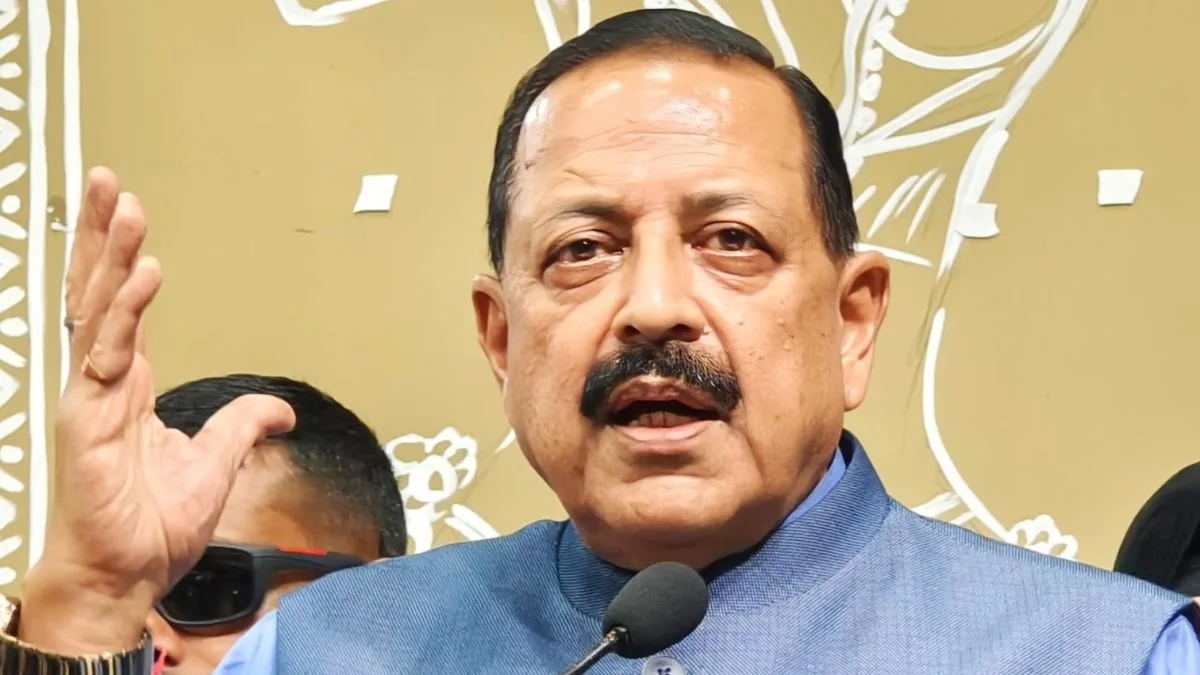


Union Minister of State for Science and Technology, Dr. Jitendra Singh, announced that Jammu & Kashmir will lead India’s journey toward Destination 2047 during a launch event at the University of Kashmir. This initiative aims to position the region as a pivotal contributor to India’s burgeoning economy.
During the launch of the ATL Sarthi and Frontier Region Programme under the Atal Innovation Mission (AIM) by NITI Aayog, Dr. Singh shared insights into how Jammu & Kashmir can become a significant part of India’s innovation landscape. He noted that as India’s economy climbs from the fourth to the third-largest globally, the value addition will primarily stem from underexplored regions, particularly Jammu & Kashmir.
Dr. Singh highlighted, “This region began receiving significant attention post-2014, under Prime Minister Narendra Modi’s leadership.” He stressed that Jammu & Kashmir’s wealth of natural resources, including the Himalayas and rivers, will cultivate economic growth through initiatives like the Aroma Mission.
With optimism, he stated that the region possesses the potential to emerge as a key player in driving India’s growth story, especially through innovation-driven efforts over the next two decades.
Recognizing the dual significance of the ATL Sarthi initiative, which aims to integrate Kashmir University into India’s growth journey, Dr. Singh celebrated AIM’s endeavor to enhance its innovation network in the Union Territory. A notable development is the announcement of 500 new Atal Tinkering Labs (ATLs) in Jammu & Kashmir, forming a substantial part of the 2,500 labs set to be established across frontier regions, with an investment of ₹100 crore.
These ATLs will equip students with exposure to advanced tools in robotics, 3D printing, and artificial intelligence, setting the groundwork for future innovators. Dr. Singh emphasized the importance of technological advancement, stating that India’s economic growth has consistently surged through sectors like space, biotechnology, and the vast resources of the Himalayas.
India’s space economy has witnessed dramatic growth—from almost nothing to an impressive $8 billion—and is projected to reach $40–45 billion within the next decade. Dr. Singh commended the role of over 400 startups actively contributing to this expanding sector.
He remarked on the necessity of public-private partnerships to sustain growth, mentioning successful models such as InSpace for space research and BIRAC for biotechnology. “Without involving private players, our growth cannot be sustained,” he commented.
Dr. Singh shed light on Jammu & Kashmir’s burgeoning role in innovative sectors like the Aroma Mission, which catalyzes the existing floriculture industry. Currently, around 3,500 lavender startups thrive in the region. He noted a trend of young professionals leaving corporate jobs to pursue entrepreneurial ventures in these fields, thereby redefining career opportunities beyond traditional government positions.
On the talent front, Dr. Singh noted that 50 students from Jammu & Kashmir achieved top positions in the nationwide School Innovation Marathon, signifying a budding talent pool. He urged students and parents to dispel the notion that successful startups can only emerge from metropolitan areas, pointing out that nearly half of India’s startups originate from Tier 2 and Tier 3 cities.
Dr. Singh concluded, “As we envision India@2047, the students in these tinkering labs will be at the forefront of the workforce. Through them, Jammu & Kashmir will proudly serve as a torchbearer of India’s national journey.”
The launch event was attended by prominent figures, including Lieutenant Governor Manoj Sinha, Chief Minister Omar Abdullah, Education Minister Sakina Masood, University Vice-Chancellor Prof. Nilofer Khan, and AIM Mission Director Dr. Deepak Bagla.