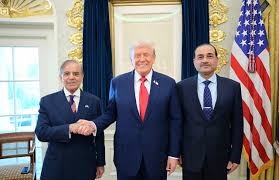


US President Donald Trump met with Pakistan Prime Minister Shehbaz Sharif and Field Marshal Asim Munir at the White House on September 26, marking a significant moment in bilateral relations. This historic meeting occurred just as Prime Minister Sharif participated in the 80th session of the United Nations General Assembly (UNGA).
This engagement represents Trump’s first formal interaction with Sharif since the latter took office, and it comes six years after former Prime Minister Imran Khan’s visit during Trump’s first presidential term. Observers expect discussions to focus on enhancing trade ties and regional security issues.
During a press interaction following the signing of several executive orders, Trump called both Sharif and Munir “great leaders.” He remarked, “In fact, we have a great leader coming, the prime minister of Pakistan and the field marshal. They’re coming,” highlighting the significance of this diplomatic encounter.
The meeting, which took place in the Oval Office, included key members of Trump’s administration, such as Vice President J.D. Vance and Secretary of State Marco Rubio. According to a statement from the Pakistan Prime Minister’s Office (PMO), the atmosphere was “pleasant,” fostering an open exchange between the leaders.
Initially scheduled to start at 4:30 PM (local time), the meeting faced a slight delay but lasted over an hour, concluding at 6:18 PM. Photographs shared post-meeting depicted Trump, Sharif, and Munir engaged in animated discussions, with the US President exhibiting his characteristic thumbs-up during a group photo.
Before the Oval Office meeting, Sharif met Trump informally in New York amidst UNGA activities on Tuesday, where they conversed about broader multilateral issues alongside leaders from Arab nations.
Discussions primarily revolved around mutual interests, including security and economic cooperation, areas that have witnessed fluctuating dynamics within US-Pakistan relations. Historically, the US and Pakistan have seen a complex relationship, transitioning from Cold War allies to examining diverging interests concerning Afghanistan and militancy.
In past months, Trump has made headlines, claiming credit for calming tensions between India and Pakistan. Despite disputes over this narrative, Pakistan’s nomination of Trump for the 2026 Nobel Peace Prize emphasizes its acknowledgment of his diplomatic engagement during critical moments.
Trump asserted his role in fostering a ceasefire between India and Pakistan after mediation efforts, insisting he helped resolve a “long night” of discussions that led to renewed hostilities acceptance by both nations. However, India continues to assert that the agreement resulted from direct dialogue between military officials of both countries.
The financial aspect of US-Pakistan relations also took center stage during this meeting. Trump’s recent negotiations established a trade agreement imposing a 19% tariff on Pakistani imports, symbolizing an effort to bolster robust economic ties. In 2024, trade between the two nations reached an estimable USD 10.1 billion, with US goods exports to Pakistan climbing to USD 2.1 billion.
Statistics reveal a noticeable increment in US imports from Pakistan, reaching USD 5.1 billion in 2024, fostering a trade deficit that climbed to USD 3 billion. This economic partnership reflects an underlying potential for a mutually beneficial relationship, sustaining growth opportunities for both countries.
The last official visit by a Pakistani prime minister to the White House was in July 2019, when Imran Khan engaged directly with Trump. This recent meeting signals a fresh chapter, as trade and diplomatic dialogues promise to shape future relations between Islamabad and Washington.
In conclusion, the meeting between President Trump and Prime Minister Sharif not only reinforced historic ties but also illuminated both nations’ intent to realign their diplomatic focus on crucial regional issues and economic growth.