
21.3 C
Jammu
Friday, October 30, 2026

J&K Govt Introduces Land Pooling Policy 2026 with 70% Consent

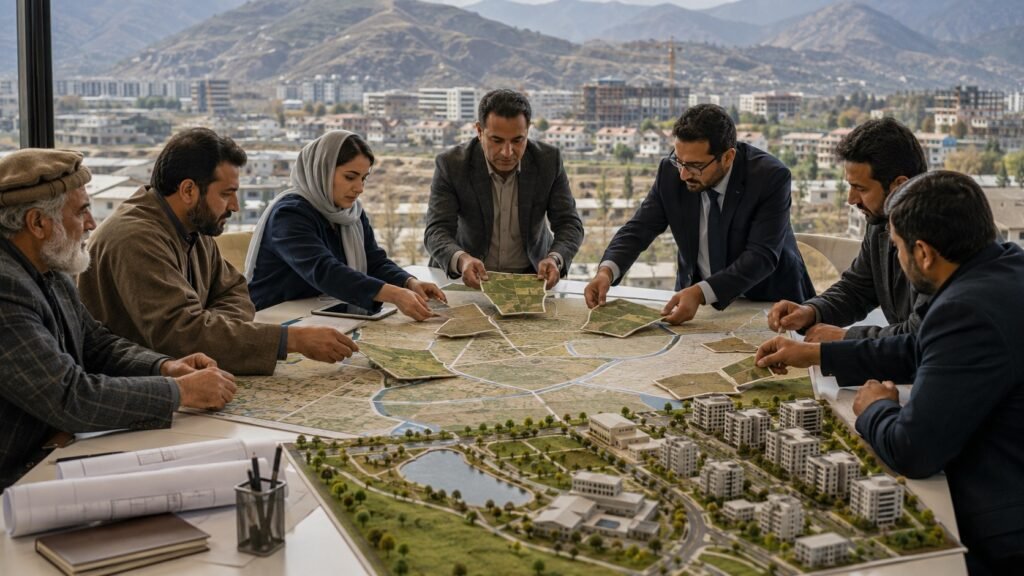
The Jammu and Kashmir Government officially notified the Land Pooling Policy 2026 as per Government Order No. 173-JK(HUD) dated August 17, 2026. This policy aims to foster organized urban growth by promoting voluntary participation among landowners willing to engage in the development process.

The policy mandates that a consortium or developer interested in a specific parcel of land must secure approval from at least 70% of the landowners in a contiguous area before proceeding with the pooling scheme. This provision is aimed at ensuring community involvement while advancing urban development.

Key to the policy is the allowance for the Developer Entity to retain up to 60% of the pooled land. Meanwhile, the remaining 40% will be handed over to the relevant Development Authority without encumbrances. This land transfer is crucial for constructing city-level infrastructure, recreational amenities, and essential public services, all aligned with the established Master Plan and Zonal Development Plans.

The pooled land can serve various planned purposes, including residential, commercial, and institutional developments, alongside neighborhood facilities. The policy emphasizes equitable redistribution among landowners, offering options like exchanged developed land or built spaces.

The Single Window Facilitation aims to streamline implementation, with the Development Authority responsible for approvals, monitoring, and coordinating basic utilities—water supply, drainage, sewage, and transportation—to facilitate smooth operations.

In addition, the Development Authority will establish a dispute-resolution mechanism and ensure that housing for the Economically Weaker Section is addressed as part of the developers’ obligations.

The policy incorporates a two-tier grievance redressal system to handle disputes effectively. The first stage includes a Grievance Redressal Committee led by the Designated Land Pooling Officer, which must resolve complaints within 30 days. If unresolved, disputes can be escalated to a second-stage committee chaired by the Vice Chairman or Chief Executive Officer of the Development Authority.

To ensure efficiency and transparency, the government will adopt an online process for land pooling schemes. This digital initiative will manage everything from applications and registrations to scheme approvals and monitoring, enhancing accessibility to the policy.

The Land Pooling Policy sets forth strict deadlines for each phase, allocating an initial 60-day period for consortium formation, extendable by an additional 30 days. Developers must submit their land pooling plans within six months of forming their consortium, with an overall completion timeframe limited to five years.

Moreover, the long-term maintenance of areas developed under this initiative will primarily remain with the Developer Entity, while the Urban Local Body will assume responsibility for infrastructure only after meeting all required standards.
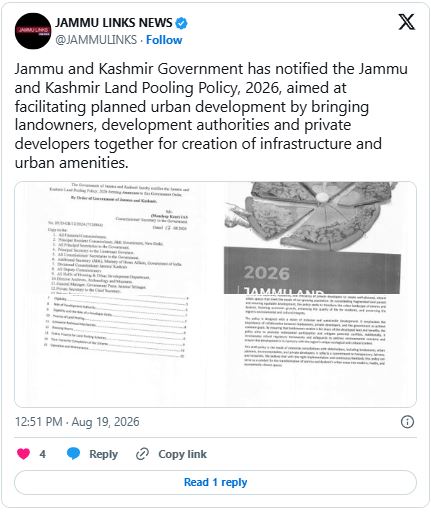

Jammu and Kashmir Land Pooling Policy 2026

Related Articles

- Advertisement -spot_img

Latest Articles

J&K Govt Introduces Land Pooling Policy 2026 with 70% Consent

The Jammu and Kashmir Government officially notified the Land Pooling Policy 2026 as per Government Order No. 173-JK(HUD) dated August 17, 2026. This policy aims to foster organized urban growth by promoting voluntary participation among landowners willing to engage in the development process.

The policy mandates that a consortium or developer interested in a specific parcel of land must secure approval from at least 70% of the landowners in a contiguous area before proceeding with the pooling scheme. This provision is aimed at ensuring community involvement while advancing urban development.

Key to the policy is the allowance for the Developer Entity to retain up to 60% of the pooled land. Meanwhile, the remaining 40% will be handed over to the relevant Development Authority without encumbrances. This land transfer is crucial for constructing city-level infrastructure, recreational amenities, and essential public services, all aligned with the established Master Plan and Zonal Development Plans.

The pooled land can serve various planned purposes, including residential, commercial, and institutional developments, alongside neighborhood facilities. The policy emphasizes equitable redistribution among landowners, offering options like exchanged developed land or built spaces.

The Single Window Facilitation aims to streamline implementation, with the Development Authority responsible for approvals, monitoring, and coordinating basic utilities—water supply, drainage, sewage, and transportation—to facilitate smooth operations.

In addition, the Development Authority will establish a dispute-resolution mechanism and ensure that housing for the Economically Weaker Section is addressed as part of the developers’ obligations.

The policy incorporates a two-tier grievance redressal system to handle disputes effectively. The first stage includes a Grievance Redressal Committee led by the Designated Land Pooling Officer, which must resolve complaints within 30 days. If unresolved, disputes can be escalated to a second-stage committee chaired by the Vice Chairman or Chief Executive Officer of the Development Authority.

To ensure efficiency and transparency, the government will adopt an online process for land pooling schemes. This digital initiative will manage everything from applications and registrations to scheme approvals and monitoring, enhancing accessibility to the policy.

The Land Pooling Policy sets forth strict deadlines for each phase, allocating an initial 60-day period for consortium formation, extendable by an additional 30 days. Developers must submit their land pooling plans within six months of forming their consortium, with an overall completion timeframe limited to five years.

Moreover, the long-term maintenance of areas developed under this initiative will primarily remain with the Developer Entity, while the Urban Local Body will assume responsibility for infrastructure only after meeting all required standards.

Jammu and Kashmir Land Pooling Policy 2026

Related Articles

- Advertisement -spot_img

Latest Articles